A visual essay · Open Linguistics — to appear (2026)
Can Word Order in the Left Periphery Emerge from Local Interactions?A Complexity-Inspired Simulation Framework
- Author
- Elena Callegari
- Affiliation
- Centre for Digital Humanities and Arts (CDHA), University of Iceland
- Contact
- ecallegari@hi.is
- Publication
- Open Linguistics — to appear (2026)
- DOI
- DOI forthcoming
02
Can word order emerge from local interactions—or does it need a blueprint?
What determines the order in which words and phrases are spoken?
Two possible explanations
The positions come first.
An ordered set of structural positions is specified in advance. Each expression is assigned to its designated position.
The order develops through interactions.
Instead of occupying predefined positions, expressions establish their relative order through repeated interactions with their neighbours.
Nothing is placed in advance.
The same order. Two different mechanisms.
03
The beginning of a sentence does important work.
The left periphery is the left edge of the clause—in English, roughly everything before the subject. It helps connect a sentence to its context, introducing topics, questions and other discourse-related information.
This book, I have only just skimmed.
Topic — what the sentence is about
What did you do?
Question word + fronted auxiliary
When several of these elements occur together, what determines their relative order?
04
A place for every piece?
In cartographic approaches to syntax, different types of constituents are associated with dedicated positions in an ordered hierarchy.
A useful analogy is a children's shape-sorting toy: each piece fits into a particular opening, and the openings are arranged in advance.
Now apply the analogy to syntax
Just as each shape has its own opening, each constituent has its own position in the hierarchy.
The following animation illustrates this using the hierarchy proposed by Frascarelli (2012).
Frascarelli (2012) · Left-peripheral hierarchy
›Go deeper
The hierarchy illustrated here is proposed by Frascarelli (2012), who distinguishes several types of topical constituents according to their discourse functions.
In particular, Shift hosts shifting (or aboutness) topics, Contr hosts contrastive topics, and Fam hosts familiar topics. These are assigned distinct positions within an ordered left-peripheral hierarchy, alongside positions associated with clause typing (Force), interrogative material (Int), focus (Foc), and finiteness (Fin).
The proposed relative order is:
Force > Shift > Contr > Int > Foc > Fam* > Fin
The asterisk indicates that multiple familiar topics may occur.
In this type of cartographic analysis, the ordering of constituents follows from their association with positions in the structural hierarchy. Crucially, however, cartographic approaches differ on whether unoccupied positions must also be structurally projected: not every account assumes that all positions are present in every sentence.
05
Complex patterns can arise from simple local rules.
Large-scale organisation can arise through repeated interactions among nearby elements.
Could local interactions also compute constituent order?
Flocking is an analogy and a motivation—not evidence that language uses the same mechanism.
06
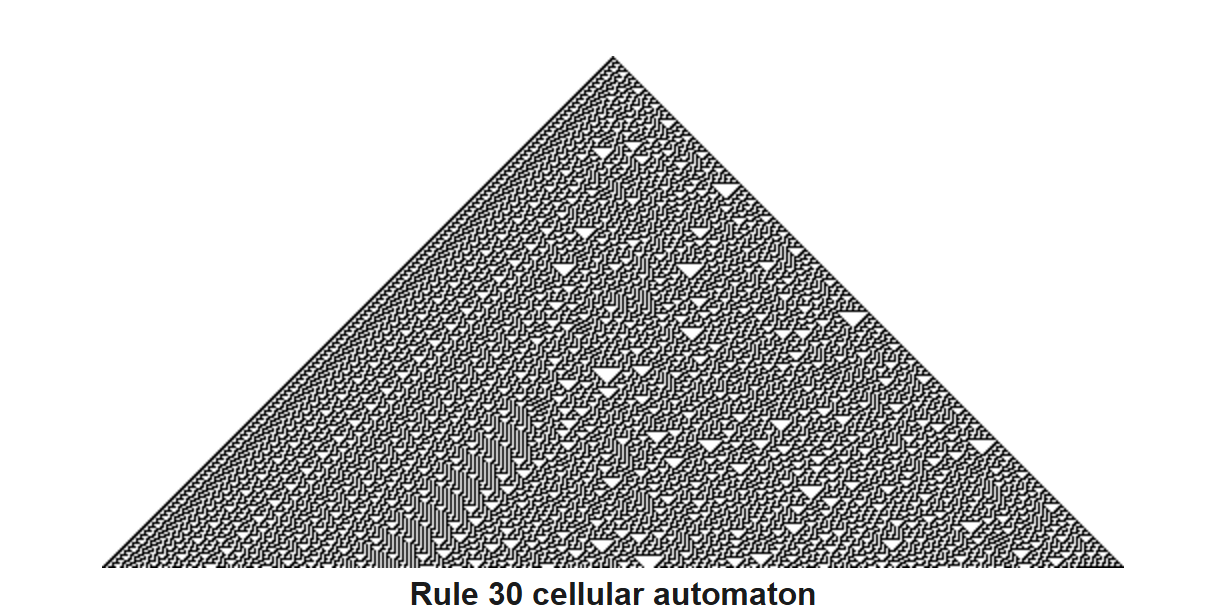
A tiny rule. An intricate pattern.
A cellular automaton is a row of cells, each on or off. Each new cell depends only on a small neighbourhood in the previous row. Start from one active cell:
›See the eight local rules
Each triple of cells in one row determines the centre cell of the next row:
The linguistic model borrows the idea of local updates—not Rule 30 itself.
Rule 30 updates binary cells simultaneously. The linguistic simulation uses multiple constituent categories and updates neighbouring pairs sequentially.
07
Compare neighbours. Apply a rule. Repeat.
Constituents are represented as agents—units that act only on local information. Local rules determine whether neighbouring elements exchange places.
Initial row: the input order.
- Only constituents present in the input participate—no empty positions waiting to be filled.
- No fixed absolute slots are consulted during updating.
- The baseline swap rules nevertheless encode ordering relations taken from existing theories.
›Go deeper
Pairs are evaluated asynchronously from right to left; at most one swap occurs per row. Each row records one update.
- Force — clause type (e.g. declarative, question)
- Shifting topic — introduces a new topic
- Contrastive topic
- Fronted focus
- Familiar topic — already given in context
08
Local rules need the right conditions.
A. Can earlier decisions be revisited?
Cascade: constituents stay available for further updates. Pairwise: each adjacent pair is evaluated only once.
Pairwise run · example (12)
Foc is fixed too early, before Contr and Int; the Fam topics end up apart.
Cascade, same input · Figure 9a
Target order reached.
B. Can every relevant neighbour participate?
In the Rizzi & Bocci (2017) implementation, a generic Top is licit in several positions. Where the rule set supplies no applicable swap, it acts as an interactional barrier.
Illustration of the mechanism
The paper reports the interrogative remaining blocked behind an undifferentiated Top (Figures 9c–d). Category distinctions and rules matter—this is a finding about these implementations, not a disproof of a linguistic theory.
09
The outcome depends on the rules—and how they are applied.
Allowing repeated local updates improved success in both implementations.
›Experiment details
Two parameters varied: reference hierarchy and update mode. Inputs were restricted to mutually compatible element sets. These are success rates of the simulation, not measures of language accuracy or human performance.
| Condition | Avg rows | Min | Max |
|---|---|---|---|
| Frascarelli (2012) · Cascade | 8.24 | 2 | 14 |
| Frascarelli (2012) · Pairwise | 7.00 | 7 | 7 |
| Rizzi & Bocci (2017) · Cascade | 3.84 | 2 | 9 |
| Rizzi & Bocci (2017) · Pairwise | 7.00 | 7 | 7 |
10
What if the same topic can end up in different places?
The proof of concept lets a topic move out of the focus domain—the portion of the clause treated as focus. Toggle whether “why” (perché) belongs to it.
Rule: the topic crosses its left neighbour only if that neighbour is marked +.
The Topic–“why” order is not stipulated in advance. It follows from the focus boundary.
Simplified model sequences: clitic resumption and other aspects of full sentence realisation are not represented.
11
Now, try the simulation yourself.
The visual essay has shown how local interactions can reorder constituents. This simulation, rebuilt from the paper's NetLogo model, lets you experiment with different initial configurations, reference hierarchies and updating procedures—and observe the resulting sequences.
Reference hierarchy
Update mode
Initial row · click a cell to change it
Derivation
Press Run or Step to apply the local rules.
Row 1 of 9
The model allows you to investigate how different local rules and updating procedures affect the resulting word order.
12
From ordering assumptions to executable explanations.
- 1
Local updates can reproduce target orders under particular conditions.
- 2
Category distinctions and continued accessibility affect the outcome.
- 3
Context-sensitive rules can produce alternative orders without fixing their relative precedence in advance.
This is a framework for investigating linearisation—not a complete theory of syntax.
›What this does—and doesn’t—show
- Baseline precedence rules are translated from existing hierarchies.
- The baseline does not independently explain where those relations come from.
- The context-sensitive proof of concept is deliberately narrow.
- Computational success does not establish that human speakers use this algorithm.